Three layers: municipality, place and barri
Most of the confusion comes from mixing up three different things. Mallorca is divided into 53 municipalities, each with its own town hall. Inside each municipality there are towns, villages, resorts and estates, the places most people actually name when they say where they live. Palma, the largest municipality by far, is also split into five administrative districts and a long list of barris, or neighbourhoods, usually counted as 88.
A place name tells you what a street feels like. The municipality tells you whose rules apply: planning, local taxes, rubbish collection, school catchments and holiday rental policy. Two homes ten minutes apart can sit under different town halls, and that can matter more than the view.
Cala Major, Sant Agustí and Illetes
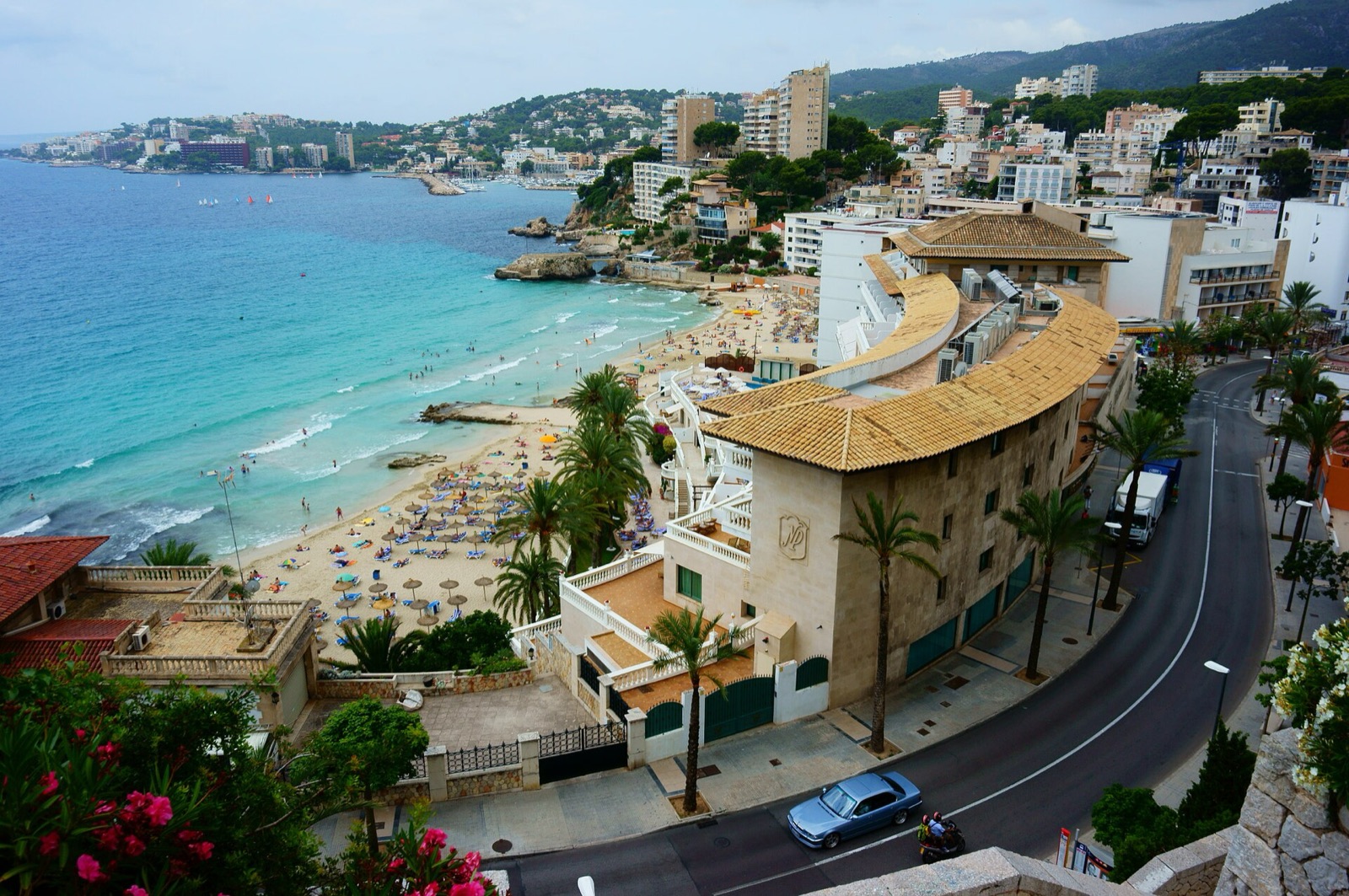
Cala Major feels like a small resort of its own, with a sandy cove, hotels and the Fundació Miró on the hill. Officially it is a barri of Palma, in the western district of Ponent. So are Portopí, at the end of the Paseo Marítimo, and Sant Agustí, just beyond Cala Major (see Portopí and Sant Agustí).
The city ends where Sant Agustí meets Cas Català. From there on you are in the municipality of Calvià, and Illetes is its first stretch of coast. Many people think of Illetes as part of Palma, because the road and the houses run on without a break. On paper it belongs to a different town hall, with its seat in the inland village of Calvià Vila.
- Palma (Ponent district): Portopí, Cala Major, Sant Agustí, Gènova, La Bonanova, Son Vida
- Calvià: Cas Català, Illetes, Bendinat, Portals Nous, Palmanova, Santa Ponsa, Peguera
- Palmanova is in Calvià, not Palma, despite the name
Portals Nous, Portals Vells and Puerto Portals
Three names, two places. Portals Nous is a coastal village between Bendinat and Palmanova, and Puerto Portals is the marina at its foot. Portals Vells is a cove with small beaches in pine forest at the southern tip of Calvià, beyond Magaluf and El Toro. Nous means new and Vells means old. Palmanova and Magaluf lie between them. The two Portals could hardly be more different: Portals Nous is a busy marina village with schools close by, while Portals Vells has fewer than 30 registered residents.
Two languages, two spellings
Mallorca has two official languages, Catalan and Castilian Spanish, and many places have a name in each. Under the Balearic language law of 1986, the Catalan form is the only official one for place names. Older maps, property portals and some road signs still use the Castilian versions, so the same place can turn up spelt two ways.
- Illetes / Illetas
- The coast west of Palma, in Calvià.
- Sant Agustí / San Agustín
- Palma’s last barri before Calvià.
- Portopí / Porto Pi
- Palma’s old natural harbour, at the western end of the seafront.
- Santa Ponça / Santa Ponsa
- Santa Ponça is the official form; this site uses the more familiar Santa Ponsa.
- Port d’Andratx / Puerto de Andratx
- Port is Catalan for harbour; the Castilian is Puerto.
Search for both forms when you look at listings, and expect the Catalan one on official papers.
The town and its port
Many coastal municipalities have an old town inland and a harbour on the coast, with the same name. Sóller and Port de Sóller are about 3 km apart. Pollença is about 6 km from Port de Pollença, and Andratx town about 5 km from Port d’Andratx. The town usually has the town hall, the health centre and the weekly market, while the port has the beach and the boats. A listing that just says Sóller or Pollença could mean either, so ask which one.
Postcodes and why it matters
Postcodes are drawn up for post delivery, not for planning, and they are not a reliable guide to where a place begins and ends. Cala Major addresses carry 07015 and the word Palma. Illetes, just along the road, has 07181 and Calvià. Nova Santa Ponsa has no code of its own and shares 07180 with Santa Ponsa. An estate name in an advert can cover several of these, or none.
Before you buy, check the municipality on the land registry extract and the cadastral record, not the advert. It decides which town hall grants building licences, sets the local property tax and handles your registration on the padró, the local residents’ register. Our guides to surveys and checks and taxes for owners explain what to look at.
Areas in this post
Cala Major · Portopí & Sant Agustí · Illetes & Cas Català · Palma
Sources
Facts in this post were checked in October 2026 against these sources.
- seuelectronica.palma.es/portal/PALMA/sede/RecursosWeb/DOCUMENTOS/1/0_9 Palma divided into five districts (2005); Ponent district barris include Portopí, Cala Major, Sant Agustí, Gènova, La Bonanova
- majorcadailybulletin.com/news/local/2016/08/13/44940/almost-palma-dist Palma counted as 88 neighbourhoods
- en.wikipedia.org/wiki/List_of_municipalities_in_the_Balearic_Islands 53 municipalities on Mallorca
- boe.es/eli/es-ib/l/1986/04/29/3/con/20120721 Llei 3/1986 de normalització lingüística: Catalan as the only official form of Balearic place names (art. 14)
- miromallorca.com/en/visitans Fundació Miró Mallorca address in Cala Major, 07015 Palma
- en.wikipedia.org/wiki/Portals_Nous Portals Nous in Calvià, Puerto Portals marina
- en.wikipedia.org/wiki/Santa_Ponsa Santa Ponça as the official Catalan form; postcode 07180
- mallorca.com/es/guia/playas/ses-illetes Illetes postcode 07181, Cas Català-Illetes, Calvià