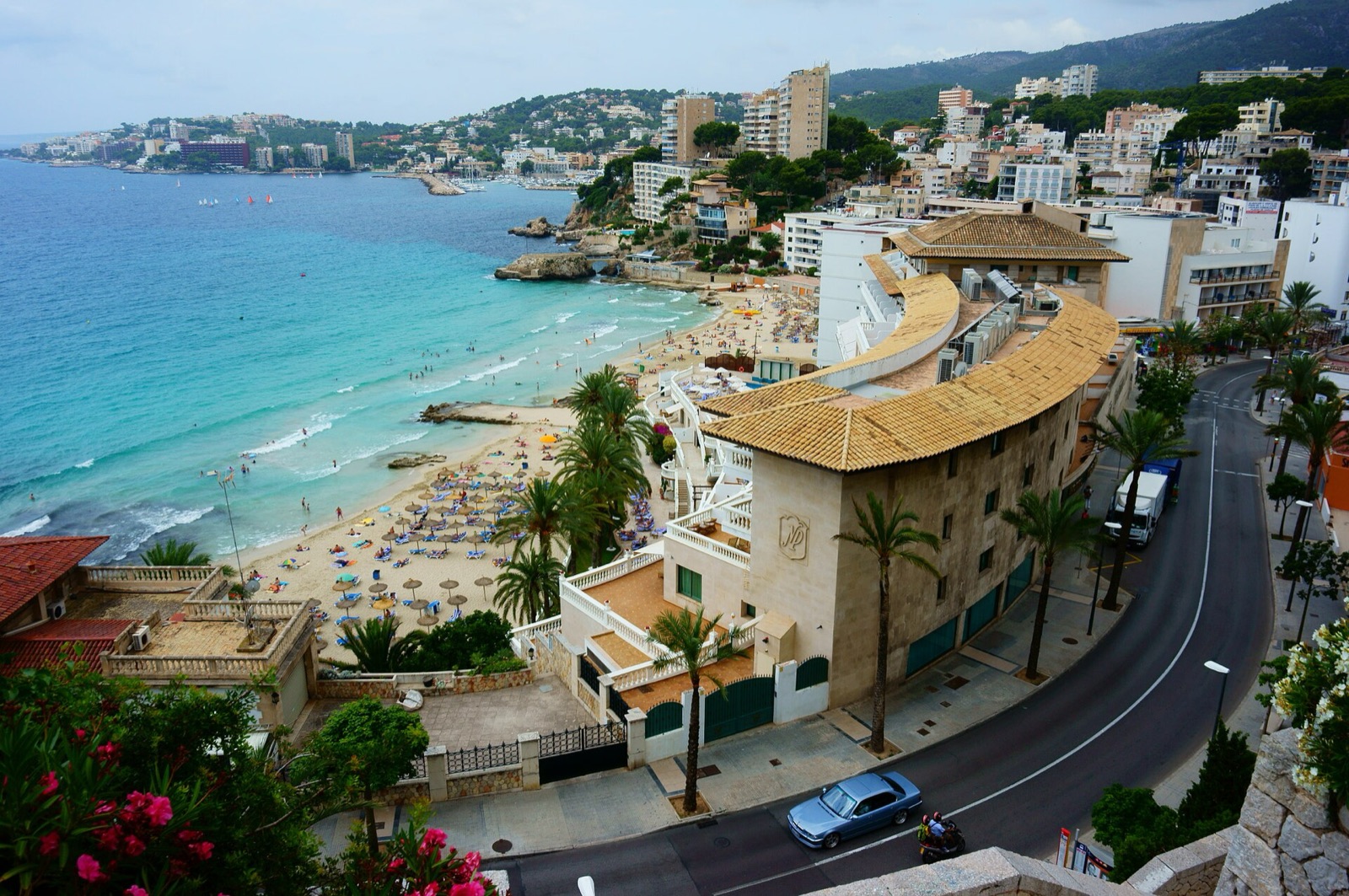
Two municipalities, four main places
Each municipality has an old town inland and a port on the sea. Pollença has the old town of Pollença, at the foot of the mountains, and Port de Pollença on its bay, about 6 km apart. Alcúdia has its walled old town and Port d’Alcúdia, with the long resort of Platja d’Alcúdia beyond, 5 to 10 minutes apart. Families usually choose between these four, so it helps to compare them in pairs.
| Pollença | Alcúdia | |
|---|---|---|
| Registered residents | Over 17,000 | Over 21,000 |
| Central Palma by car | About 50 to 60 min | About 50 to 60 min |
| Main beach | Port de Pollença: sand, pines, shallow water | Platja d’Alcúdia: long, fine sand, very gently shelving |
| Feel | Mountains, valleys, a market town | Walled town, big resort, working harbour |
| Airport bus | None in the municipality | All year from the port |
Schools
Both have a full set of state schools, which matters if children will join the Spanish system. Pollença town has two state primary schools, the Monti-sion school and a state secondary, IES Guillem Cifre de Colonya. Port de Pollença has two more primaries, a nursery and its own secondary school, IES Clara Hammerl. In Alcúdia, five state primaries serve the old town and the port, and there are two state secondaries, IES Moll Vell in the port and IES Alcúdia in the town.
For a British-curriculum education, the nearest option is Mallorca International School, known as MYSCHOOL, a private school in Crestatx, on the edge of sa Pobla, roughly between the two. Most of the island’s other international schools are around Palma and Calvià, about an hour away.
Beaches and the outdoors
Both bays suit small children. In Port de Pollença the beach runs south of the harbour with pines just behind it, and the seabed shelves gently. North of the harbour, the car-free Pine Walk leads past small beaches. Platja d’Alcúdia is longer and wider, with fine sand that shelves very slowly, and it carries on as Playa de Muro.
Pollença is the place for mountain walks, with the Tramuntana on the doorstep, the Bóquer valley and the Formentor peninsula. Alcúdia has the pine-covered Victòria hills, the s’Albufera wetlands, a natural park since 1988 and a favourite with birdwatchers, and ferries from the port to Menorca.
Life through the year
Pollença town and Alcúdia old town are the steadiest places to live. Each has its town hall, a health centre and markets all year: Sunday in Pollença, Tuesday and Sunday in Alcúdia. Pollença’s health centre has out-of-hours urgent care, and the public hospital for both is in Inca, roughly 20 to 30 minutes away by car.
The ports change more with the seasons. Port de Pollença keeps its schools, shops and Wednesday market and becomes much quieter in winter. Port d’Alcúdia and Platja d’Alcúdia are larger resorts, so more restaurants and hotels close from late autumn to spring, though thousands of people live there all year.
Homes and getting around
Pollença offers townhouses in the old town, flats and older villas in the port, and many country houses in the valleys, many of them let to holidaymakers. Alcúdia offers townhouses inside the walls, many flats in the port and resort, and houses with gardens in Alcanada, Bonaire and Mal Pas. With any rural house, ask your lawyer to check that everything built is legal. See buying a finca.
For getting about, Alcúdia has the edge: an airport bus runs from the port all year, and the nearest train station, at sa Pobla, is a little closer. Both reach Palma by the Ma-13 motorway. Pollença has buses to Palma all year, but no airport bus of its own. If children will commute to Palma or one parent flies often, that difference adds up.
Areas in this post
Sources
Facts in this post were checked in October 2026 against these sources.
- nabss.org/colegios-nabss/myschool MYSCHOOL - Mallorca International School, British National Curriculum, Carrer del Llorer 1, Crestatx, sa Pobla
- en.wikipedia.org/wiki/Clara_Hammerl IES Clara Hammerl in Port de Pollença named after the teacher Clara Hammerl
- caib.es/sites/escolaritzaciocurs/ca/adscripcions_mallorca State schools: CEIP Joan Mas, CEIP Miquel Costa i Llobera, CC Monti-sion, IES Guillem Cifre de Colonya (Pollença); CEIP Miquel Capllonch, CEIP Bocchoris, IES Clara Hammerl (Port de Pollença); five CEIPs, IES Alcúdia and IES Moll Vell (Alcúdia)
- tib.org/en/w/els-usuaris-del-bus-tib-milloren-la-connectivitat-amb-la- TIB buses serving Pollença, Port de Pollença and the Bay of Alcúdia
- majorcadailybulletin.com/holiday/airport/2024/03/22/122237/how-get-fro Airport bus to Alcúdia; Pollença reached by changing in Alcúdia or by line 301
- caib.es/sites/espaisnaturalsprotegits/ca/parc_natural_de_salbufera_de_ S’Albufera natural park, declared 1988 (Decree 4/1988)
- boe.es/eli/es/rd/2025/12/03/1117 Official municipal population figures on 1 January 2025: Pollença 17,807, Alcúdia 21,907