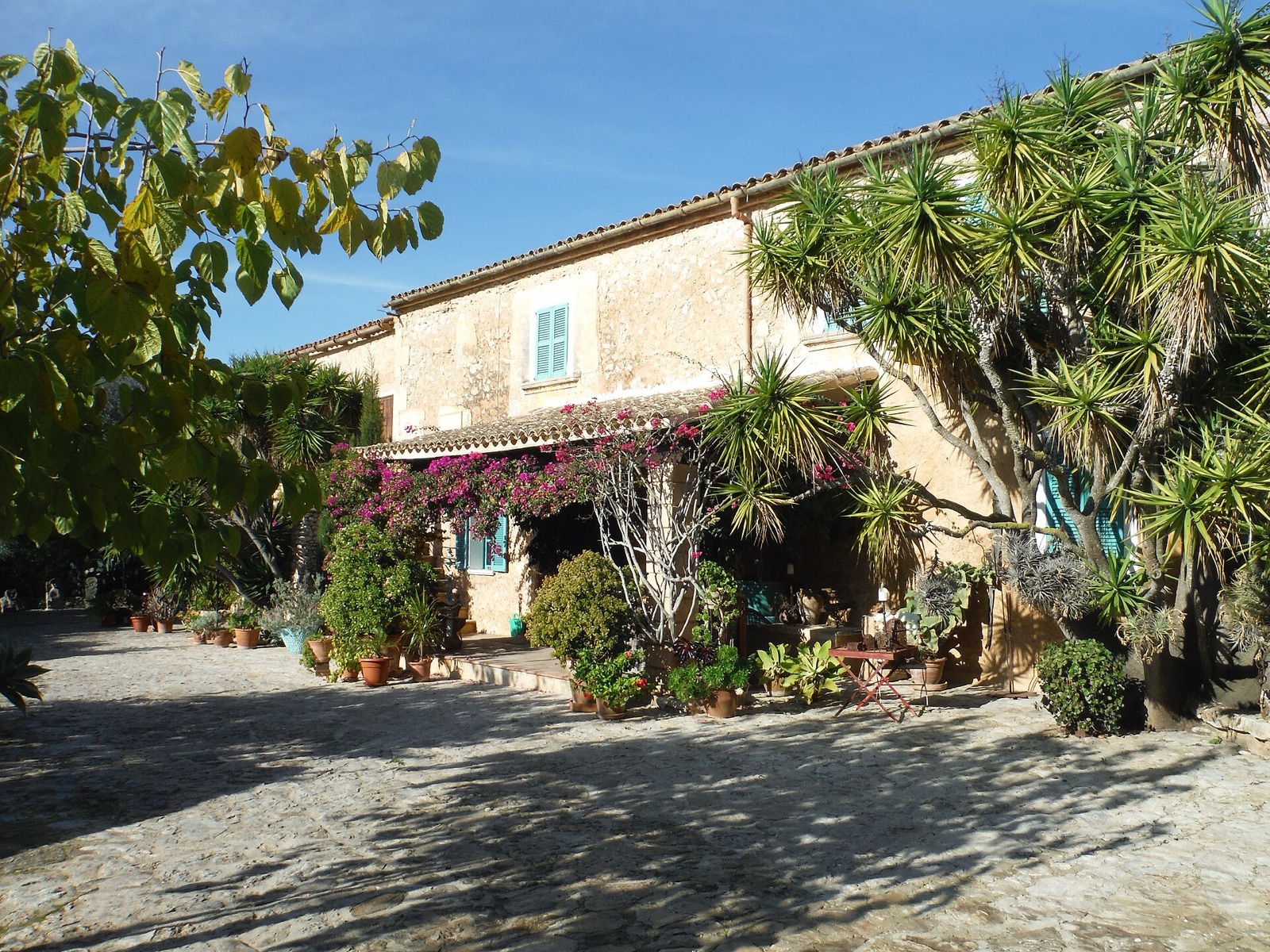
A planned town on a ridge
Montuïri is a small town in the Pla, the farming plain at the centre of the island. It stands on a low ridge about 170 metres up, and from the plain below its roofs, church tower and windmills stand out against the sky.
Its shape goes back to 1300, when King Jaume II made it a royal town and gathered the scattered farmers of the area into one planned village. Each family was given a plot, and the streets were laid out in a regular grid along the ridge. That grid survives. Carrer Major runs down the spine of the town, and the Plaça Major holds the town hall and the parish church of Sant Bartomeu, begun in the early 14th century, with a bell tower started in 1552. The smaller Plaça Vella is where the town began, and some of its oldest houses, with round-arched doorways, are still there.
The windmills of the Molinar
The windmills are on the south side of town, in the Molinar quarter, the oldest and highest part of Montuïri. Eight of them stand along Carrer des Molinar, each known by a name, and most of them date from the 17th century, when a network of flour mills grew up to grind the grain of the plain. Their round stone towers still give the town its outline.
One of them, the Molí des Fraret, has a second life. It belongs to the town council, was restored, and since 2001 has housed the archaeological museum of Son Fornés.
Son Fornés, three thousand years back
Son Fornés lies about 2.5 km from the centre on the road to Pina. It is a Talaiotic settlement, built from around the 9th century BC and lived in until Roman times. The site covers more than three hectares, only a small part of it excavated, and one of its talaiots, the stone towers typical of Mallorca’s prehistory, is the largest documented on the island, about 17 metres across.
The museum in the Molí des Fraret tells the settlement’s story through its finds, from the Talaiotic period to the first century AD. Research at the site is linked to a team from the Universitat Autònoma de Barcelona. Opening days are limited, so check the museum’s current hours before you go.
The Cossiers and the town’s year
Montuïri is best known in Mallorca for its Cossiers, a troupe of six dancers with a Lady (sa Dama) and a Devil, known locally as Banya Verda. The dancers wear paired costumes in yellow, pink and green with wide straw hats, and they are accompanied by the flabiol, a small flute, and a drum. The dance ends with the Lady overcoming the Devil.
They come out only three times a year: on 15 August, on 23 August, the eve of Sant Bartomeu, and on 24 August, the feast of the town’s patron saint. The troupe is first recorded in 1750, and the town hall describes it as the only one on the island that has danced without interruption. The fiestas of Sant Bartomeu fill most of August.
The rest of the calendar is shaped by the church and the land. On the Tuesday after Easter, the Dia des Puig, people walk up to the oratory of the Mare de Déu de la Bona Pau on the Puig de Sant Miquel, the hill east of town, where a hermit was recorded in 1396. On the first Sunday of December the Fira de sa Perdiu holds a contest of decoy partridges.
Getting around: the Ma-15 and the buses
The Ma-15 dual carriageway between Palma and Manacor passes the southern edge of town. Palma is about 35 to 40 minutes away by car outside rush hour, the airport a little less, and the Hospital de Manacor about 20 to 25 minutes to the east. Many residents commute along this road to work in Palma or Manacor.
TIB buses also use the Ma-15 corridor. Line 401, between Cala Millor, Manacor and Palma, stops at Montuïri through the day, and line 403 from Campos adds more trips to Palma’s Estació Intermodal. The stop is on Carrer de la Constitució, at the edge of town, and a free municipal minibus links it with the centre.
What living here is like
Montuïri is a working village. Cereals, almonds, figs and apricots grow on the plain around it, and old vegetable gardens with water wheels still ring the town. The weekly market fills the Plaça Major on Monday mornings.
- Health: a public health unit in town sees patients on weekdays. Out-of-hours care is at the Vilafranca health centre, about 15 minutes away, and the area’s hospital is in Manacor.
- Schools: a municipal nursery and the state primary school, CEIP Joan Mas i Verd. Secondary pupils go to IES Porreres, 10 to 15 minutes away.
- Everyday services: a public library, a municipal music school and door-to-door rubbish collection.
- The coast: the nearest beach is Es Trenc, about half an hour away via Porreres and Campos.
What Montuïri offers is space and countryside rather than sea views: a village house on the old grid, or a country house on the farmland around it. Before you buy, know that the new general plan was given initial approval in July 2025, and licences were suspended where the new rules change what is allowed. Have a lawyer check the planning position, and see our notes on buying a finca and on the surveys and checks worth doing. For the wider plain, start with our Pla zone page.
Areas in this post
Sources
Facts in this post were checked in November 2026 against these sources.
- ajmontuiri.net/ca/nucli-urba Medieval grid along the ridge following Jaume II’s ordinances, Carrer Major as main axis; Plaça Major with town hall and church of Sant Bartomeu; Plaça Vella as origin; Molinar quarter and its eight windmills; mill names and dates, most 17th century, one 19th century
- ajmontuiri.net/ca/notes-historiques 1300: Jaume II makes Montuïri a vila, concentrating the dispersed population and giving each family a plot; network of windmills created in the 17th century, surviving mills of the 17th and 18th centuries; first settlement at least 9th century BC
- ca.wikipedia.org/wiki/Montu%C3%AFri Town on a rise of about 170 m in the Pla; Ma-15 Palma–Manacor; most residents work in Palma or Manacor; Fira de sa Perdiu first Sunday of December; Son Fornés inhabited from about 900 BC through the Talaiotic and post-Talaiotic periods, declining after the Roman conquest from the 1st century AD
- turismemontuiri.com/que-veure Son Fornés over 3 ha, about 15% excavated, on the Ma-3200 to Pina 2.5 km from town; largest talaiot in Mallorca, 17 m across; museum in the 18th-century Molí des Fraret since 2001, limited opening days; church begun early 14th century, bell tower 1552; Plaça Vella houses with round-arched doorways; eight named mills on Carrer des Molinar in the oldest and highest part of town; Bona Pau hermitage (1396) on the Puig de Sant Miquel and Dia d’es Puig on the Tuesday after Easter; Monday market 8 to 13 h in the Plaça Major
- uab.cat/web/seus/presentacio/presentacio-1345837076836.html UAB: Son Fornés site and museum in the restored Molí des Fraret, owned by the town council, on the road to Pina; exhibition from the Talaiotic period to the 1st century AD; UAB research group ASOME linked to the site
- ca.wikipedia.org/wiki/Cossiers_de_Montu%C3%AFri Six cossiers and the dama, with the dimoni Banya Verda; dances on 15, 23 and 24 August; first documented in 1750; flabiol and tamborí; yellow, pink and green paired costumes and straw hats; dama tramples the dimoni at the end
- ajmontuiri.net/ca/fires-festes-i-mercats Town hall: cossiers the only troupe on the island maintained without interruption; Fira de sa Perdiu with decoy partridge contest on the first Sunday of December; Dia del Puig; Monday market
- ultimahora.es/noticias/part-forana/2026/08/23/2694473/cossiers-montuir Cossiers on the eve of Sant Bartomeu 2026; tradition kept without interruption for close to three centuries
- ajmontuiri.net/sites/cilma_montuiri/files/2026-07/PROGRAMA%20ST.%20BAR Sant Bartomeu 2026 programme running through August; Cossiers on 15, 23 and 24 August
- ajmontuiri.net/ca/transport-public Bus stop on Carrer Constitució 59; free municipal minibus linking the stop with the town centre (line numbers on this page are out of date, see TIB)
- tib.org/documents/20124/420692/L401%2C+des+de+2026.03.27.pdf/f4c2df4d- TIB line 401 Cala Millor–Manacor–Palma timetable with Montuïri stops
- tib.org/documents/20124/420692/L403%2C+des+de+2026.09.01.pdf/36b691ca- TIB line 403 Campos–Algaida–Palma timetable serving Montuïri and Palma Estació Intermodal
- ibsalut.es/apmallorca/ca/ap-mallorca/centres-de-salut/cs-vilafranca-se UBS Montuïri open Monday to Friday (Tuesday afternoons); reference centre CS Vilafranca
- ibsalut.es/apmallorca/ca/ap-mallorca/centres-de-salut/cs-vilafranca-se CS Vilafranca in the Llevant sector (Hospital de Manacor) with PAC out-of-hours care
- ajmontuiri.net/ca/educacio Municipal nursery, CEIP Joan Mas i Verd, municipal music school
- caib.es/sites/escolaritzaciocurs/ca/adscripcions_mallorca CEIP Joan Mas i Verd feeds IES Porreres for ESO
- ajmontuiri.net/ca/lentorn-i-recursos-naturals Market gardens with sínies around the town; well-preserved farmland
- caib.es/eboibfront/pdf/ca/2025/102/1197313 BOIB 102, 2 August 2025: initial approval of Montuïri’s general plan by the plenary on 31 July 2025; suspension of licences where the new rules change the planning regime, for two years or until provisional approval; no later approval stage found in BOIB search (November 2026)
- ajmontuiri.net/ca/biblioteca-i-arxiu Municipal library
- ajmontuiri.net/ca/residus Door-to-door rubbish collection
- router.project-osrm.org Drive times from the church: Palma about 35 min, airport about 31 min, Hospital de Manacor about 21 min, Sa Ràpita (Es Trenc) about 32 min via Porreres and Campos, Porreres about 11 min, Vilafranca about 11 min (as in the Montuïri area guide)