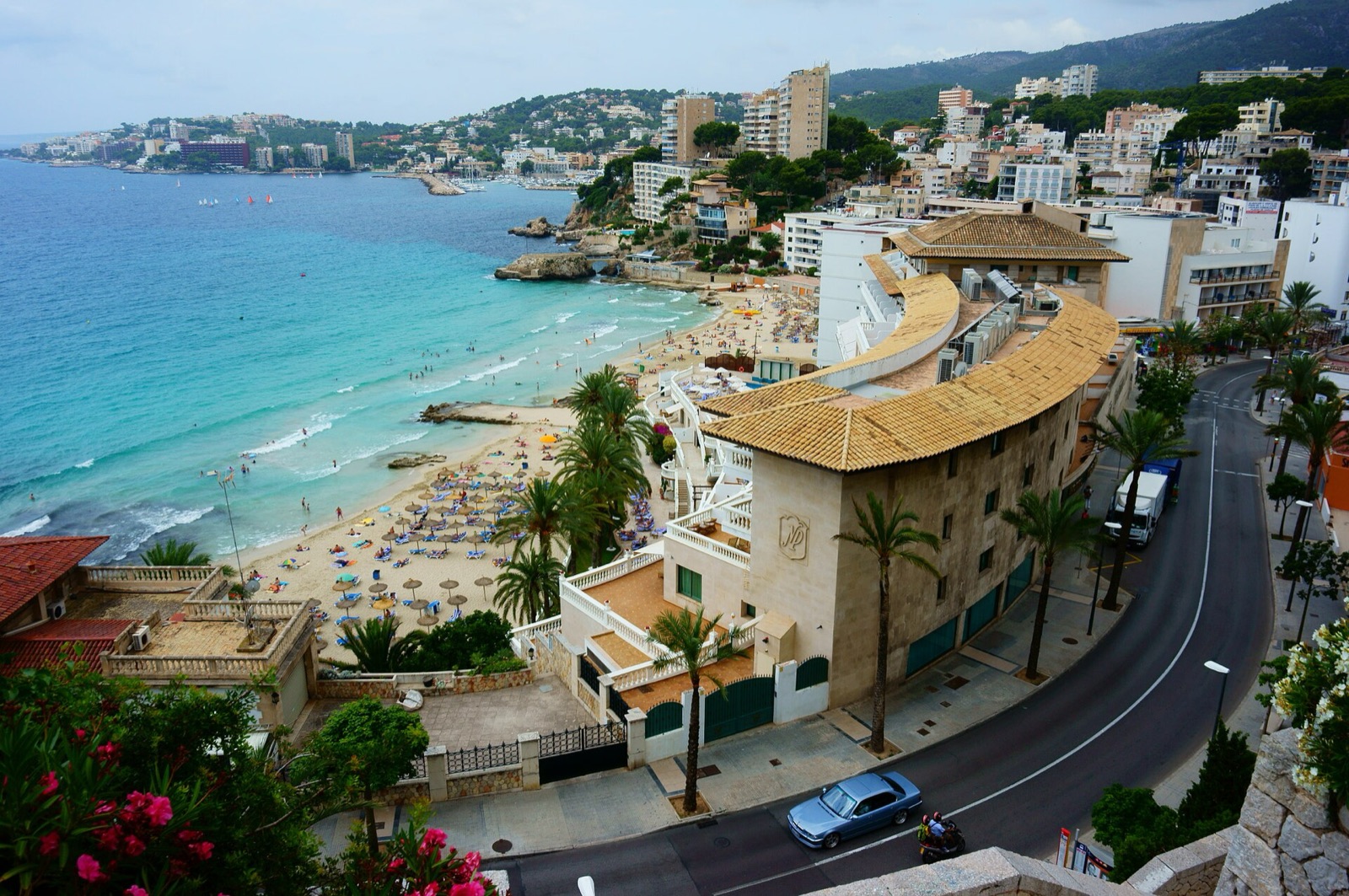
Why July is the real test
Most viewings happen in spring or autumn, when almost any house is comfortable. The test comes in July and August. AEMET’s long-term averages for Palma airport give an average daily high of just over 31 degrees in both months, and heatwaves push well beyond that. A house that cannot stay cool costs you sleep, electricity and patience.
The good news is that much of the answer is built into the house, and you can check most of it on a viewing.
By the sea or inland: hot days or warm nights
Where the house stands changes the kind of heat you live with. Compare two AEMET stations over 1981 to 2010. At Palma airport, a few kilometres from the sea, July averages a high of 31.2 degrees and a low of 18.3. At the station in Palma’s port, right on the water, the average high is lower, at 29.4, but the average low is 21.9.
That is the pattern to expect. The sea softens the afternoons but keeps the nights warm and humid, so a seafront flat in Palma or a resort may need cooling at night for much of the summer. On the plain of the Pla, afternoons are hotter, but the air usually cools more after dark, and an inland house with good cross-ventilation can often be cooled by opening up the windows at night.
Near the coast, the embat, the sea breeze that usually sets in during the morning and fades towards evening, takes the edge off the afternoon. A terrace that catches it is worth a lot in July.
Orientation and shade
Ask which way the main rooms, bedrooms and terraces face, and check with a compass on your phone. West-facing windows take the low, strong afternoon sun at the hottest time of day, and west walls keep giving off heat into the evening. South-facing windows get a high summer sun that a roof overhang, a pergola or an awning can block, and a low winter sun that is welcome. North and east rooms make the coolest bedrooms.
Shade does more than any machine. Look for external shutters, deep window reveals, covered porches and terraces, and trees on the south and west sides. Traditional Mallorcan houses use slatted wooden shutters that keep the sun out while letting air through. Blinds or curtains inside the glass help much less, because by then the heat is already in the room.
Walls, roofs and windows
Old stone houses in the villages and the countryside often have very thick walls. They take a long time to warm up, which keeps rooms cool through a hot day, but after a long heatwave they release that stored heat slowly too, so night ventilation matters.
In newer houses and flats, the roof is often the weak point. A top-floor flat under a poorly insulated flat roof can be the hottest home in the building. Ask when the building went up, whether the roof has been insulated and what windows are fitted. Double glazing in insulated frames helps in summer as well as in winter.
Every seller must provide an energy performance certificate under Royal Decree 390/2021, and a copy goes with the sale contract. Its rating is not a test of summer comfort, but it can flag poor insulation and glazing. An independent survey can go further.
Air conditioning: what to check
- Which rooms have units, how old they are, and whether they heat as well as cool. Most modern heat-pump units do both, which also helps in winter.
- Where the outdoor units sit. In a block of flats, putting a unit on the façade or a shared roof normally needs the agreement of the community of owners under Spain’s Horizontal Property Law.
- Noise. Outdoor units close to a neighbour’s window can lead to disputes, and one in a building in Palma’s old town ended with a court ordering the units removed.
- In historic centres and protected buildings, local planning rules can limit visible units, so ask the town hall before planning new ones.
- Whether the contracted electricity supply is enough to run several units at once.
- Ceiling fans. They are cheap to run and often mean the air conditioning can be set less cold, or left off.
A July checklist
- If you can, visit in summer, once in the afternoon and once in the evening.
- Stand in the top-floor rooms and on the west side at the end of the afternoon.
- Open windows on opposite sides and see whether air moves through the house.
- Ask the owner how they use the air conditioning and which rooms they sleep in during August.
- Look at the outdoor space at midday: is there anywhere shaded to sit?
Sources
Facts in this post were checked in October 2026 against these sources.
- aemet.es/es/serviciosclimaticos/datosclimatologicos/valoresclimatologi Palma airport climate normals 1981–2010: July mean high 31.2, mean low 18.3; August 31.3 and 18.9
- aemet.es/es/serviciosclimaticos/datosclimatologicos/valoresclimatologi Palma port climate normals 1981–2010: July mean high 29.4, mean low 21.9
- ca.wikipedia.org/wiki/Embat Embat sea breeze: sets in during the morning, lasts into the afternoon, eases afternoon heat
- agenergia.iter.es/wp-content/uploads/2018/05/1234185246_guiaGreenpeace West-facing walls the main summer problem; external shading keeps sun out better than internal
- boe.es/buscar/act.php?id=BOE-A-2021-9176 Royal Decree 390/2021: energy performance certificate required when selling; copy attached to the sale contract
- boe.es/buscar/act.php?id=BOE-A-1960-10906 Horizontal Property Law, article 7: alterations to common elements such as the façade need community consent
- ultimahora.es/noticias/local/2024/02/28/2114583/aire-acondicionado-mal Court ordered removal of air-conditioning units disturbing neighbours in a building in Palma’s historic centre